


Beyond open and close
When automated windows are written into a BMS specification, the requirement often stops at “windows to open and close on command from the BMS”. That is the straightforward part. The more useful questions are what the BMS actually knows about each window once the command has been sent, whether the window reached the position it was asked for, and how quickly anyone finds out when it didn’t.
MotorLink® is WindowMaster’s answer to those questions. WindowMaster describes it as the standard for interfacing BMS systems and window actuators: a digital data communication technology that enables two-way control and feedback between window actuators and the building management system. In practical terms, it turns the relationship between the facade and the BMS from a one-way instruction into a two-way exchange.
For building services engineers writing controls specifications, and architects relying on automated openings to deliver a ventilation strategy, understanding what MotorLink® does helps set realistic expectations for how the facade will behave once the building is occupied. It also shows why the choice of actuator and controller matters as much as the choice of window.
The limits of a simple open/close signal
A conventional actuator responds to power. Drive it one way and the window opens; reverse it and the window closes. The control system can send the instruction, but it generally has no way of confirming the result. The BMS assumes a window is open because it asked it to be.
On a small installation with a handful of switched windows, that may be acceptable. On a commercial building where dozens or hundreds of openings form part of a natural or mixed-mode ventilation strategy, those assumptions add up. A window that has stopped part-way, a sash held shut by an obstruction, or a fault on a single motor line can go unnoticed until occupants complain about comfort or someone walks the facade.
Partial openings are the other limitation. Comfortable ventilation, particularly in cooler weather, often depends on small, controlled openings rather than fully open sashes. Without reliable position control, a small opening is difficult to hold consistently. A window that opens further than intended can create draughts and lose heat the building has paid to generate.
As WindowMaster puts it, not all actuators are designed to operate intelligently, and this has a direct effect on building performance, overall costs and occupant comfort.
What MotorLink® is, in plain terms
MotorLink® is built into compatible WindowMaster actuators and controllers. Each MotorLink-enabled actuator contains microprocessors that allow it to communicate with its controller in both directions. The controller tells the actuator what to do, and the actuator reports back what it has actually done: where the window is, how it is moving and whether anything has gone wrong.
It helps to think of the system in three layers:
- The actuator moves the window and reports its position and status.
- The MotorController or smoke panel manages groups of actuators over MotorLink®, and handles local switches, sensors and control logic.
- The BMS communicates with the controller using an open protocol.
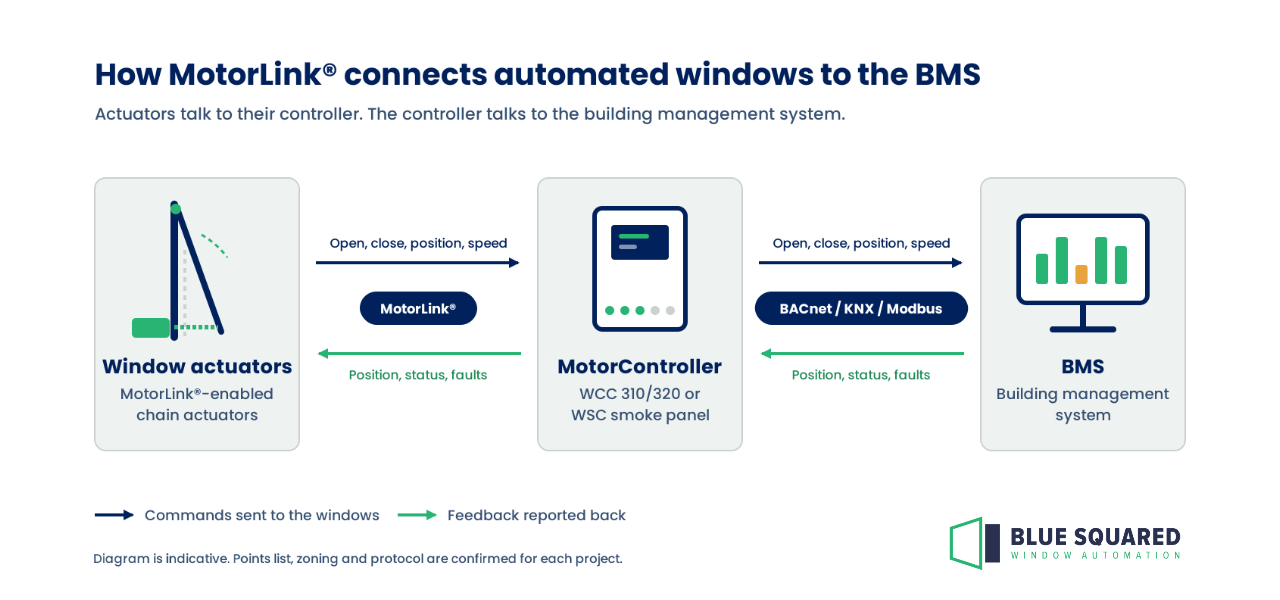 That middle layer is the key to understanding the integration. The BMS does not talk to every motor individually. MotorLink® handles the conversation between the actuators and their controller, and the controller presents the facade to the BMS in a protocol the building already uses.
WindowMaster notes a practical installation benefit of this arrangement. Because the MotorLink® MotorControllers manage the communication from the window actuators to the BMS, there is less cabling running directly to the BMS.
How MotorLink® connects to the BMS
MotorLink® integrates with open bus communication standards, and Blue Squared systems support BACnet, KNX and Modbus. WindowMaster describes MotorLink® as able to connect with any BMS or BAS a facility uses. In practice, this means the window system can sit within the building’s existing controls architecture rather than alongside it as a separate system.
This flexibility matters for the BMS contractor and the mechanical engineer. WindowMaster highlights that the range and functionality of MotorLink® allow BMS suppliers and facade companies to deliver control solutions tailored to specific project requirements, such as the local climate, outdoor pollution and noise.
For the BMS, the result is that each window or group of windows becomes a set of usable data points rather than a simple output. Depending on how the system is configured, the BMS can send commands such as open, close and position setpoints, and read back position, open-window status and fault information. Exactly which points are exposed, and at what level of grouping, is something to agree between the window automation specialist, the BMS contractor and the mechanical engineer during design.
What two-way communication makes possible
WindowMaster summarises MotorLink® around five core functions: position control and feedback, three-speed operation, a reversing function, genuine synchronisation and online parameter set-up. Each one has a direct effect on how the facade performs.
Accurate positioning and feedback
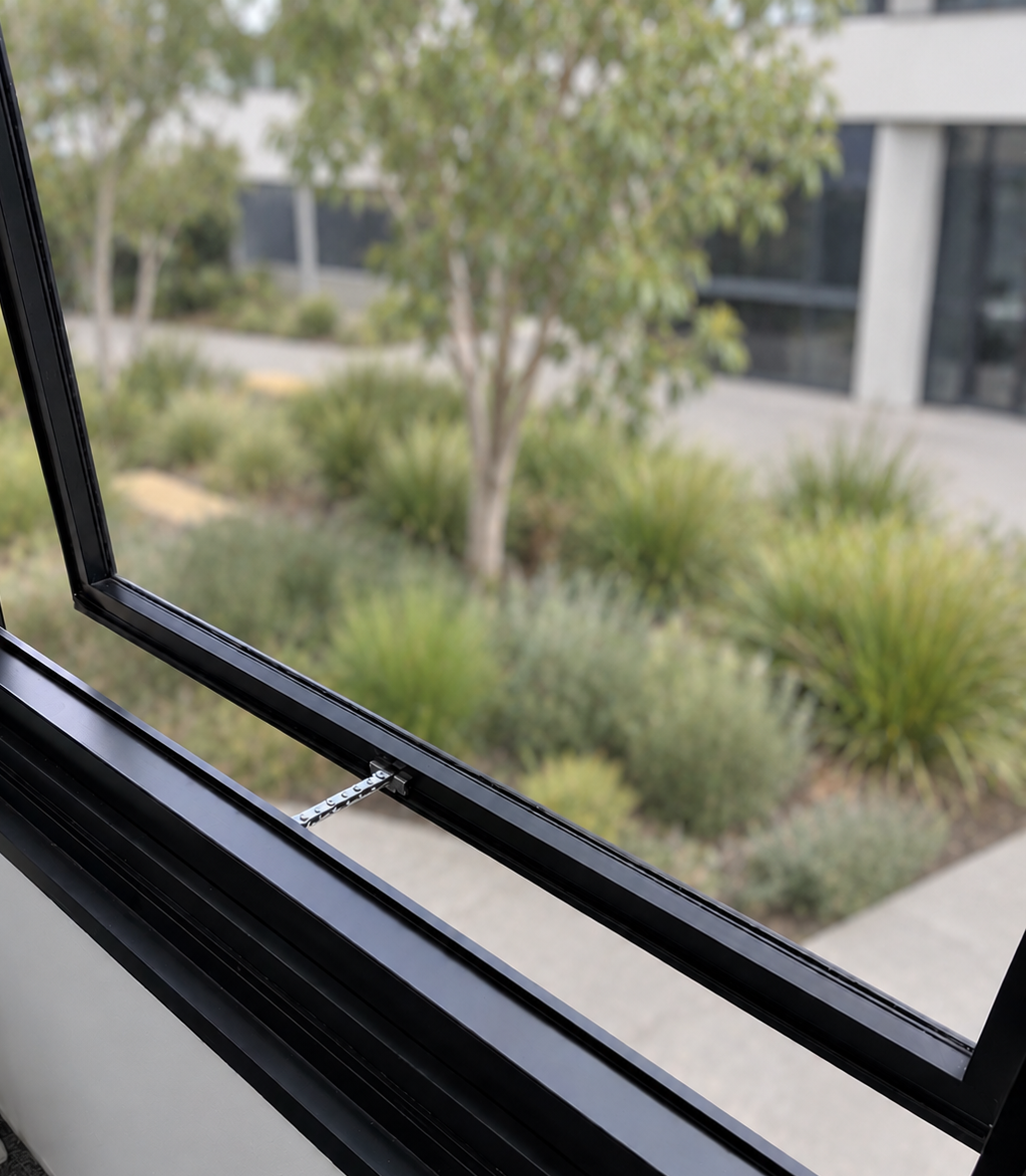 MotorLink® allows actuators to run at a precise speed and to a specific degree of opening, rather than simply open or closed, with real-time feedback of openings to the BMS. WindowMaster’s specification guidance describes this feedback as precise millimetre by millimetre, along with a security indicator for open windows.
For the mechanical engineer, this means the ventilation strategy can call for a defined opening and the BMS can confirm it has been achieved. WindowMaster notes that position feedback offers accurate positioning even for the minimum opening areas commonly required for comfortable ventilation.
It also matters after hours. For night-cooling strategies, the technology helps ensure openings remain within allowed security limits, and the open-window status gives facility managers confidence that the building is secure.
Fault reporting
Because actuators report status as well as position, faults are reported to the BMS in real time. WindowMaster’s guidance specifies that the actuator should give an early indication of any errors with the actuator operation or the wiring.
Instead of being discovered during a facade inspection or after a complaint, a fault appears alongside the building’s other monitored services, where facility managers can act on it. On large facades, this is often the difference between a minor maintenance task and a ventilation zone that quietly stops working.
Three-speed operation
MotorLink® actuators can move at different speeds depending on why they are moving. WindowMaster states that its actuators are the only ones on the market able to operate at three different speed levels:
- Automatic mode runs at a very slow speed. WindowMaster’s TrueSpeed™ makes operation nearly soundless, so windows adjusting throughout the day don’t disturb occupants in classrooms, meeting rooms or open-plan offices.
- Manual mode runs faster when an occupant presses a keypad, so there is an immediate visual response to the user.
- Emergency mode runs at full speed during smoke clearance in the event of fire.
This matters more than it might first appear. A naturally ventilated building may adjust its windows many times a day. If each movement is audible, occupants notice, and ventilation strategies that occupants notice tend to get overridden.

Synchronised movement
Wider vents may need more than one actuator. WindowMaster’s guidance is that where opening vents are around 1,200 mm wide or more, the window or curtain wall supplier should check with the profile systems house whether two actuators are required. This is dictated by frame flex and the ability to achieve a seal at the edges with a single pull point.
Where two actuators are needed, MotorLink® synchronises their speed and time of operation so the sash moves evenly and seals correctly. WindowMaster refers to this as genuine synchronisation.
Across a facade, the same function keeps multiple windows moving smoothly together when opening and closing. WindowMaster describes this as enabling synchronised, dynamic facades with the highest level of facade aesthetics. For architects, it is often the most visible sign of a well-specified system: rows of windows opening to the same angle at the same moment, rather than staggering open one after another.
Pressure safety and the reversing function
When closing, a MotorLink® actuator monitors in real time the electrical current being drawn and the precise position of the window, to an accuracy of less than a millimetre. If an object becomes trapped at the leading edge of the window, the actuator detects it, stops closing and reverses to release the obstruction.
WindowMaster describes the pressure safety function as the defining factor that can reduce a potentially severe injury to a minor pinch. The same reversing function also helps protect weather seals.
The sensitivity of this function must be adjustable. As WindowMaster explains, pressure safety is a factor of the actuator’s closing force combined with the size and weight of the window, its configuration, its hinges and the rigidity of the profile. The overall performance depends on all of these factors together. It needs to be monitored and adjusted, because the forces involved can change over the life of the building. This makes it a commissioning task rather than a factory setting.
Online parameter set-up
WindowMaster also lists online parameter set-up among the core MotorLink® functions. Because actuators communicate digitally with their controller, their operating parameters can be configured through the control system as part of commissioning, rather than relying solely on fixed settings in each motor.
What this means for building performance
The individual functions add up to a facade that behaves predictably and can be managed like any other building service.
WindowMaster points to several performance outcomes. Two-way communication enables the BMS to position windows accurately, which eliminates unnecessary heat loss and reduces cost. Control of the exact window position helps prevent draught issues. And automated, reliable operation reduces the time spent manually opening and closing windows.
There is a broader point about ventilation strategy. Natural and mixed-mode ventilation depend on windows doing what the strategy expects, consistently, over many years. A strategy designed around controlled minimum openings, night cooling or pulse ventilation only works if the windows can hold those positions and report when they can’t. MotorLink® provides the feedback loop that makes the strategy verifiable rather than assumed.
Where MotorLink® sits in the Blue Squared range
MotorLink® is not a separate product added at the end of a project. It is a capability of the actuators and controllers selected, so it needs to be considered when those products are chosen.
Blue Squared’s WindowMaster chain actuators, including the WMU 831, WMU 836 and WMU 842, are MotorLink-enabled.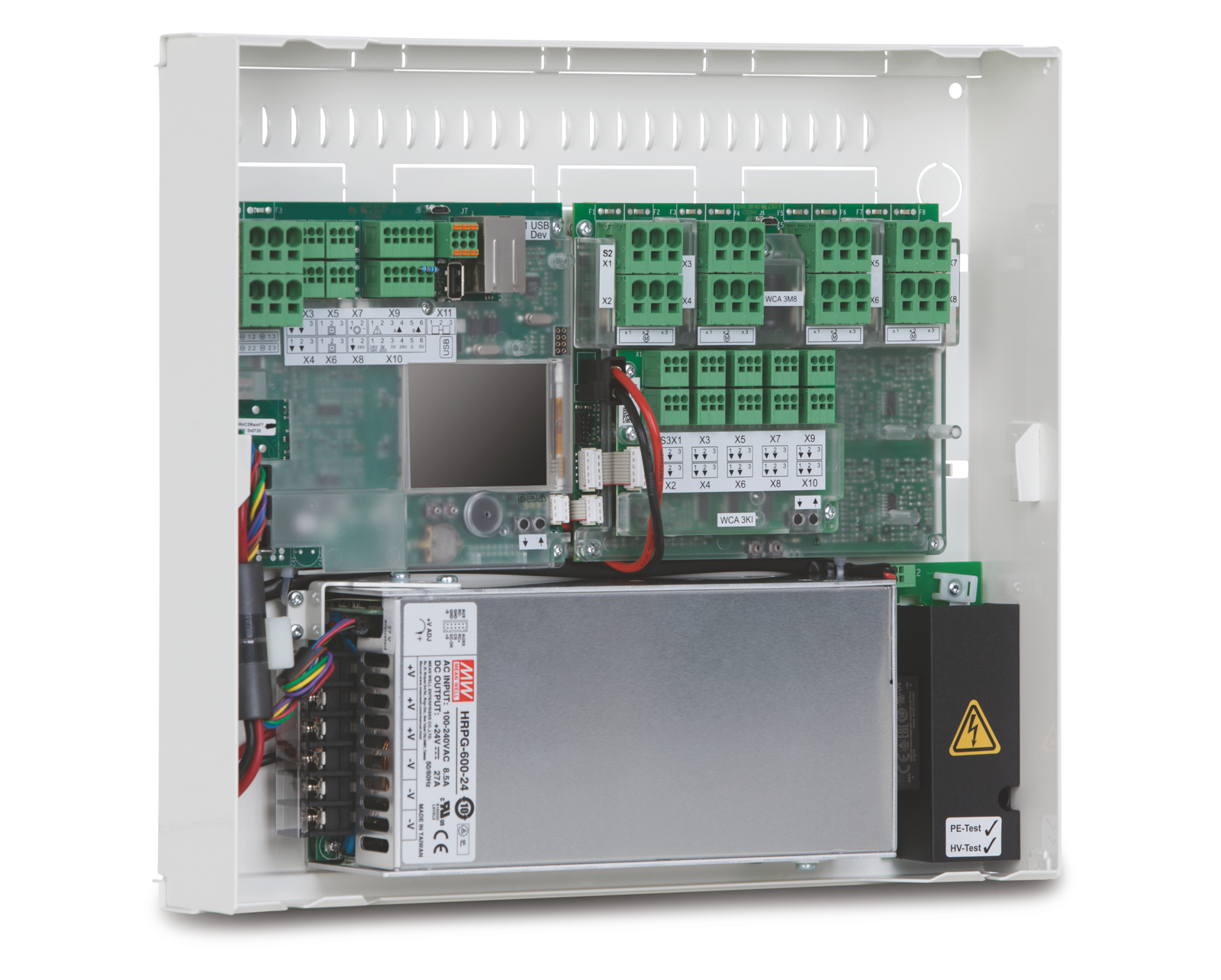
For comfort ventilation with BMS integration, the WCC 310/320 MotorController controls both standard ±24V DC actuators and actuators with MotorLink®, as well as espagnolette and locking actuators. It responds to signals from keypads, room sensors, weather sensors and BUS commands, and is available in four variations:
- WCC 310/320 Standard. Up to 8 motor lines and 10 inputs, 10A or 20A output. KNX certified.
- WCC 310/320 Plus. Up to 10 motor lines and 12 inputs, 10A or 20A output, with a built-in touchscreen for configuration. KNX certified, Modbus compliant, and BACnet compliant and BTL tested.
- WCC 310/320 Standard UL and WCC 310/320 Plus UL. UL versions of the Standard and Plus controllers, rated for a 120V supply.
The protocol the BMS uses therefore shapes the controller choice. A KNX-based system can work with either the Standard or the Plus. Where the BMS communicates over BACnet or Modbus, the Plus is the relevant option.
For smaller applications, the WCC 106 A MotorController 6A also offers MotorLink® functionality across up to two ventilation zones, with hard-wired switches or wireless operation by remote control or app. It isn’t listed with fieldbus communication, so where the BMS needs to communicate directly with the window system, the WCC 310/320 is the relevant controller.
Where openings also serve a smoke-control function, WindowMaster’s WSC smoke panels support MotorLink® and handle both smoke and comfort ventilation. The Blue Squared range includes the CompactSmoke™ WSC 106 MH S, the WSC 310/320 Plus, and the FlexiSmoke™ WSC 520, 540 and 560 panels, with fieldbus communication available on the larger panels.
The practical lesson is that a project specifying BMS integration with position feedback cannot select a controller on motor-line count alone. The controller follows from what the BMS is expected to do and the protocol it uses.
Why it matters at specification stage
A specification line such as “automated windows to be BMS-controlled” doesn’t distinguish between a system that can only switch windows and one that can position them, report back and diagnose faults. If those functions are needed, the specification should say so explicitly.
WindowMaster’s own specification guidance gives a useful model. It sets out that the actuator must provide two-way communication with the control panel to enable:
- Very slow, near-silent operation in automatic mode, and faster operation from manual keypads
- Feedback to the control software on the exact window position, for precise opening and control
- Feedback on window status and early indication of errors with actuator operation or wiring
- Synchronised speed and time of operation where multiple actuators serve one vent
- An adjustable pressure safety function that detects entrapment and reverses the actuator
Writing requirements at this level gives the BMS contractor, mechanical engineer and window automation specialist a shared understanding of what the system must deliver. It also makes clear at tender whether an alternative actually meets the brief.
Timing matters too. Decisions about controller locations, motor lines, cable routes through window profiles and the number of actuators per vent are far easier to resolve during design than once the facade is fabricated.
Coordination questions to resolve early
Before tender, it is worth the project team agreeing:
- The protocol. Which protocol the BMS uses, confirmed with the BMS contractor rather than assumed.
- The points list. What the BMS will send (open, close, position setpoints) and what it needs to read (position, open-window status, faults).
- Zoning. How windows are grouped into ventilation zones, and which groups the BMS controls independently.
- Control priority. Where the logic sits for rain and wind sensors, local switches and BMS overrides, and which takes precedence.
- Actuators per vent. Which openings need two synchronised actuators, confirmed with the window supplier and profile systems house.
- Fire system interfaces. Where the same openings also serve a smoke-control function, how the comfort ventilation and smoke modes interact.
- Responsibilities. Who programs the window controllers, who integrates with the BMS, who installs and terminates cabling, and who witnesses testing.
- Commissioning. How each point will be tested end to end, from the BMS front end through to the window itself, including setting the pressure safety sensitivity for each window type.
These questions sit across facade, mechanical, electrical and controls scopes. Left unresolved, they tend to surface as gaps between trades at commissioning, which is the most expensive time to find them.
A note on smoke control
Because WindowMaster’s smoke panels support MotorLink® and can manage both smoke and comfort ventilation, the same openings can often serve both functions. Where automated windows form part of a smoke-control strategy, however, the required operation, fail-safe behaviour, priorities and fire-system interfaces are set by the project’s fire engineer and the fire-engineered solution. MotorLink® provides the capability; the fire-engineered strategy determines how it is used.
Conclusion
MotorLink® is easy to overlook because, from the street, a window opening is a window opening. The difference sits in what the building knows. With two-way communication, the BMS can position windows accurately, confirm what they are doing, move them quietly and in step, protect occupants and seals, and flag faults before they become comfort complaints.
Getting that value depends on decisions made early: specifying the functions the BMS needs, selecting compatible actuators and controllers, and agreeing the points list, control priorities and responsibilities across the project team.
Integrating window automation into your BMS specification? We can walk you through MotorLink® on your next project. Contact us at sales@bluesquared.com.au.